
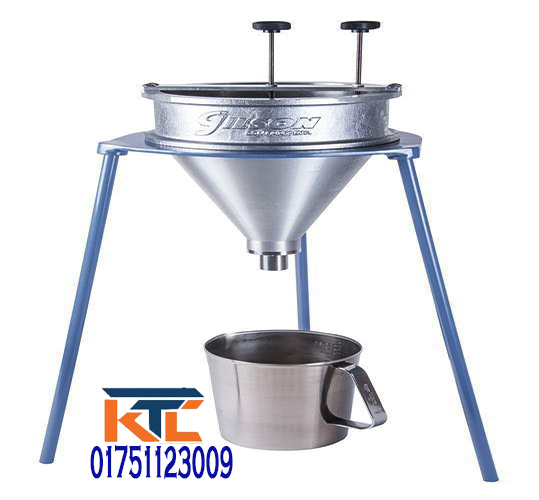

grout flow cone test apparatus:-
A grout flow cone test apparatus is a laboratory and field testing device used in civil engineering to measure the flowability, fluidity, and viscosity of neat cement grouts, fluid mortars, and preplaced-aggregate concrete grouts. It measures the time (in seconds) required for a fixed volume of grout to flow through a standardized discharge tube.
High-quality Grout Flow Cone Test Apparatus according to ASTM C939 standards. Measure grout efflux time, flowability, and consistency. Get the best price today!”
Looking for a reliable Grout Flow Cone Test Apparatus? Test cement grout fluidity & viscosity easily with our ASTM C939 compliant flow cone kit. Order now!
What is it grout flow cone test apparatus?
It is a funnel-shaped cone (typically made of cast aluminum or stainless steel) mounted on an adjustable ring stand. The apparatus operates under the standardized testing specification ASTM C939 (or EN 445 in Europe). It determines the efflux time—the duration needed for a precise volume ($1,725\text{ mL}$) of grout to discharge completely through a narrow discharge tube at the bottom.
When is it used grout flow cone test apparatus?
-
On-Site Quality Control: During active grouting operations to ensure batch-to-batch consistency before pumping grout into ducts, anchors, or foundations.
-
Mix Design Verification: During initial laboratory trials to determine the optimal water-cement ratio and dosage of superplasticizers or admixtures.
-
Pre-Grouting Verification: Prior to grouting post-tensioning tendons or cable ducts to confirm the mix is fluid enough to prevent air entrapment or blockage.
Where is it used grout flow cone test apparatus?
-
Post-Tensioned Concrete Bridges & Structures: Ensuring grout fills narrow tendon ducts completely without leaving voids.
-
Preplaced Aggregate Concrete (PAC): Testing grout injected into formwork pre-packed with coarse aggregate.
-
Soil & Rock Anchors / Tiebacks: Ground improvement, foundation stabilization, and slope protection projects.
-
Machine Foundations & Baseplates: Heavy machinery installation where high-flow non-shrink grout is needed under steel plates.
-
Concrete Repair & Injection: Crack filling and structural rehabilitation work.
Why is it used grout flow cone test apparatus?
-
Prevents Duct Blockage: If the grout is too thick (high efflux time), it can jam pumping equipment or leave air pockets inside structural ducts, leading to tendon corrosion.
-
Prevents Segregation & Bleeding: If the grout is too thin (low efflux time), the solids can settle out, leading to excess surface water and low compressive strength.
-
Ensures Code Compliance: Verifies that the grout batch conforms to project specifications and international standards (ASTM C939 / EN 445).
Which types of grout are tested?
-
Fluid Cementitious Grouts: Neat cement-water pastes with or without chemical admixtures.
-
Preplaced-Aggregate Concrete Grouts: Grouts mixed with fine aggregate passing through a No. 8 ($2.36\text{ mm}$) sieve.
-
Non-Shrink Grouts: Precision grouts used for baseplate bedding.
Note: It is not suitable for thick, non-fluid, or thixotropic mortar mixes containing coarse aggregate particles larger than $2.36\text{ mm}$, as larger particles plug the $12.7\text{ mm}$ discharge tube.
Technical Specifications & Components
| Component | Standard Dimension / Specification |
| Top Interior Diameter | $178\text{ mm}$ ($7.0\text{ in}$) |
| Cone Body Height | $190\text{ mm}$ ($7.5\text{ in}$) |
| Upper Cylinder Section | $75\text{ mm}$ ($3.0\text{ in}$) height |
| Discharge Tube Diameter | $12.7\text{ mm}$ ($0.5\text{ in}$) inner diameter |
| Discharge Tube Length | $38.1\text{ mm}$ ($1.5\text{ in}$) |
| Test Volume | $1,725\text{ mL}$ (indicated by internal point gauge) |
| Standard Test Code | ASTM C939 / CRD-C 611 / EN 445 |
How the Test is Performed (Procedure)
-
Moisten Cone: Dampen the inside of the cone and close the bottom outlet tube with a finger or stopper grout flow cone test apparatus.
-
Fill Sample: Pour grout into the cone until it contacts the point of the internal level indicator ($1,725\text{ mL}$).
-
Release & Time: Open the outlet tube and start a stopwatch simultaneously.
-
Record Time: Stop the stopwatch the exact moment light becomes visible through the discharge tube (continuous stream stops). This recorded duration is the Efflux Time (typically $11\text{–}30\text{ seconds}$ depending on specification).
Be the first to review “grout flow cone test apparatus 2026 best”
You must be logged in to post a review.
Related products

Reviews
There are no reviews yet.