
Ktcdhaka of slide calipers:
We always try to sell civil technical ktcdhaka of slide product and always flexible with customer we try to do business nicely.
calipers of (China)
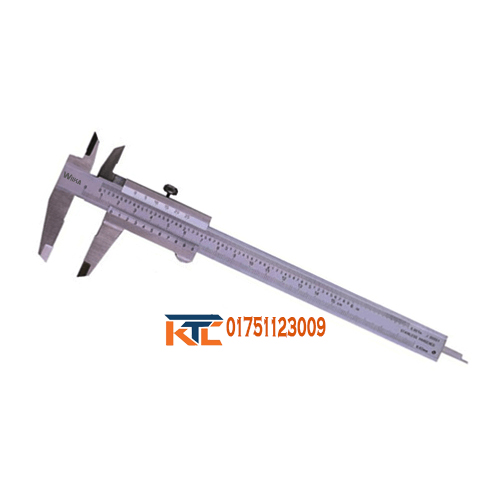
A slide calipers (commonly known as a Vernier caliper, dial caliper, or digital caliper) is a precision linear measuring instrument designed to measure internal dimensions, external dimensions, and depths with high accuracy—typically down to $0.02 \text{ mm}$ ($0.001 \text{ in}$).
Working Principle & Mechanics slide calipers:-
The slide calipers working principle of a relies on comparing two linear scales: a fixed main scale and a sliding auxiliary scale (the Vernier scale, dial gauge, or digital sensor assembly).
-
Vernier Type: Uses the difference between divisions on the main scale and vernier scale to resolve fractions of a millimeter without estimation.
-
Dial / Digital Type: Converts linear movement along a rack-and-pinion mechanism or capacitive linear encoder directly to a readable display.
Core Functions & Applications slide calipers:-
| Aspect | Details |
| What it Measures |
• External diameter & thickness (Lower large jaws)
• Internal diameter & slot width (Upper small jaws)
• Hole depth & step height (Rear sliding depth probe) |
| When to Use | Use whenever standard rulers or tape measures lack necessary resolution—specifically when tolerances require precision under $0.1 \text{ mm}$. |
| Where Used | Mechanical workshops, CNC machining, quality control labs, construction fabrication, automotive repair, and educational laboratories. |
| Why Use It | Versatility (combines 4 measuring functions in 1 tool), rapid readout, portability, and repeatable accuracy. |
How Essential is a Slide Caliper?
A is an essential primary measurement tool in design, manufacturing, and quality verification. Without it:
-
Manufactured parts cannot be verified against engineering design tolerances.
-
Mating components (e.g., shafts and bearings) risk assembly failure due to improper clearances.
-
Material thickness and pipe/conduit dimensions cannot be accurately verified during procurement or quality control checks.
Practical Operating Steps slide calipers:-
-
Zero Calibration: Close the of slide calipers jaws completely and verify that the scale reads exactly zero. Note any zero error ($\pm$) to offset final calculations.
-
External Measurement: The slide calipersPlace the object between the main lower jaws and tighten the thumb screw lightly until contact is solid without over-compressing.
-
Internal Measurement: Insert the upper internal jaws inside a bore or slot and extend until both jaw faces contact the inner walls.
-
Depth Measurement: Rest the base of the main beam flat against the top edge of a hole and extend the depth rod until it touches the bottom.
-
Reading the Value: Lock the slider screw, read the main scale mark immediately to the left of the slider zero, and add the matching alignment division from the Vernier scale (or read directly from the dial/digital screen).
Difficulties & Potential Errors slide calipers:-
-
Parallax Error: The slide calipers On manual Vernier models, looking at scale line alignments from an angle introduces reading errors.
-
Over-tightening: Excessive force flexes the jaws or deforms soft materials, producing an inaccurate smaller reading.
-
Zero Offset: Dirt or metal debris caught between jaw faces causes systematic measurement bias.
-
AbbÉ Principle Violation: Because the slide calipers measuring axis is offset from the scale axis, any wear or play in the slider mechanism introduces angular distortion errors.
A slide caliper (commonly known as a Vernier caliper) is a precision measuring instrument used in physics, engineering, manufacturing, and carpentry to measure linear dimensions with higher accuracy than a standard ruler. It typically measures down to 0.02 mm or 0.001 inches.
Common Applications of slide calipers:-
-
Outer Dimensions: Measuring wall thickness, pipe outer diameter, or bar stock.
-
Inner Dimensions: Checking bore sizes, tube internal diameters, and slot widths.
-
Depth & Step Measurements: Determining blind hole depths, slot depth, and step offsets.
Be the first to review “slide calipers 2026”
You must be logged in to post a review.
Related products


Reviews
There are no reviews yet.