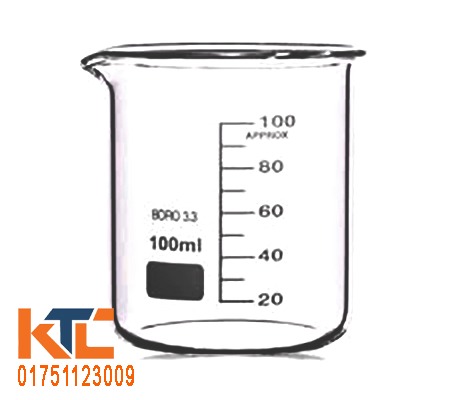
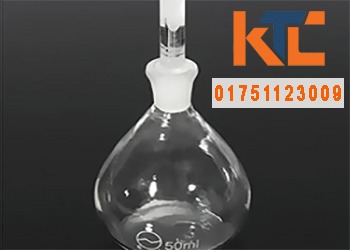
25ml, 50ml, 100ml, 250ml
What is a pycnometer:
A pycnometer is a specialized laboratory instrument used to measure the density and specific gravity of liquids and solids with high precision.1 While simple in design, it is an essential tool in chemistry, pharmacology, and material science for quality control and research.
A best pycnometer in Bangladesh (derived from the Greek word puknos, meaning “dense”) is typically a flask made of glass with a close-fitting ground glass stopper.3 This stopper features a fine capillary tube running through its center, which allows air bubbles to escape and ensures a precise volume of liquid is contained.
Unlike a standard graduated cylinder, which measures volume based on visual markings, best pycnometer inBangladesh relies on mass-based measurements. Because volume can change with temperature are often calibrated at a specific temperature (usually 20°C or 25°C) to ensure the highest accuracy.
Key Types of best pycnometers:
-
Gay-Lussac Pycnometer: The standard glass bottle used for liquids.
-
Gas Pycnometer: Uses gas displacement (usually Helium) to measure the volume of solid objects or powders.
-
Hubbard Pycnometer: Used for viscous materials like bitumen or heavy oils.
How Does a best Pycnometer Work?
The fundamental principle of a best pycnometer is the displacement of fluid.7 Density (8$\rho$) is defined as mass (9$m$) divided by volume (10$V$):
By knowing the exact volume of (which is constant) and measuring the mass of the fluid inside, you can calculate the density. When measuring solids measures the volume of liquid displaced by the solid, step-by-Step Procedure: How to Use best pycnometer:-
To get the most accurate results, follow these steps carefully. For this example, we will measure the density of a liquid.
1. Cleaning and Drying
The best pycnometer must be perfectly clean and dry. Any residue or moisture from previous tests will add mass and skew your results. Wash it with distilled water and a solvent (like acetone), then dry it thoroughly using a stream of filtered air.
2. Weighing the Empty Pycnometer
Place the empty, dry(with its stopper) on an analytical balance.12 Record this mass as $m_{0}$.
3. Filling with Reference Liquid (Calibration)
To find the exact volume of the flask, fill it with a liquid of known density (usually distilled water).
-
Fill the flask to the brim.
-
Insert the stopper; excess liquid will exit through the capillary.
-
Wipe the outside dry.
-
Weigh the filled (15$m_{water}$).
4. Filling with the Sample Liquid
Empty and dry the flask again. Fill it with your sample liquid using the same technique as step 3. Ensure there are no air bubbles, as these occupy space but have negligible mass.17 Weigh the filled($m_{sample}$).
5. Calculations
First, find the mass of the sample:
Then, calculate the density using the known volume of the flask or by comparing it to the water weight (Specific Gravity):
Best Practices for High Accuracy
-
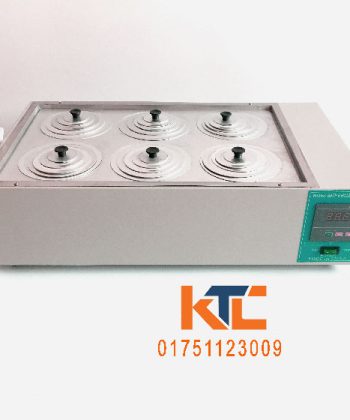
Temperature Control: Density varies with temperature.18 Always perform measurements in a temperature-controlled environment or use a water bath.
-
Avoid Hand Heat: Use gloves or tongs when handling. The heat from your hands can cause the liquid to expand, pushing it out of the capillary.
Why is the Pycnometer Important?
In industries like winemaking, fuel production, and pharmaceuticals, knowing the exact density is crucial for determining concentration and purity.20 The r remains the “gold standard” because it is a primary measurement method


Reviews
There are no reviews yet.