
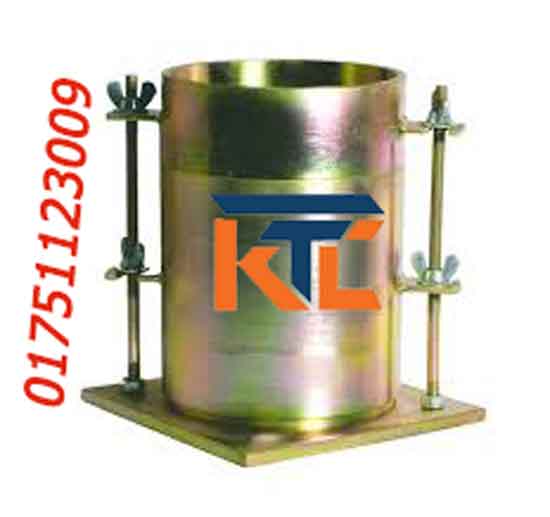
Description of CBR mold:
Thank you for providing this information about the California Bearing Ratio (CBR Mold) Set. It seems you have a good understanding of its components, features, and intended use. Here are some things I can do with this information:
- Answer your questions about the CBR Mold Set: If you have any specific questions about its use, components, or applications, feel free to ask.
- Help you find specific parts or accessories: If you need to purchase the CBR Mold Set or any of its accessories, such as the BRA-61 Spacer Disc or Soil Compaction Hammers, I can help you find online retailers or manufacturers.
- Provide additional information about CBR testing: If you’re interested in learning more about CBR testing in general, I can share information about the test procedure, its applications, and how the CBR Mold Set is used in the process.
- Compare Set to other similar products: If you’re looking for alternatives to Set, I can compare it to other products on the market based on factors like price, features, and customer reviews.
Please let me know how I can assist you further with this information or anything else related to CBR testing.
What is a CBR Mold?
A California Bearing Ratio (CBR) mold is a heavy-duty, cylindrical metal mold used in geotechnical engineering and civil construction. It is specifically designed to test the strength and load-bearing capacity of subgrade soils, subbases, and base course materials used in pavement design (such as roads, highways, airport runways, and parking lots).
-
Standard Composition: Typically made of corrosion-resistant steel or plated metal.
-
Standard Components: A cylindrical mold body (usually 152.4 mm in diameter and 177.8 mm in height), a detachable collar, a perforated base plate, and a surcharge weight to simulate the weight of overlying pavement layers.
Why is a CBR Mold Used?
The primary purpose of using a CBR mold is to determine the CBR value of a soil sample. The CBR test is a penetration test that compares the bearing capacity of a material with that of a standard crushed limestone material (which has a defined CBR value of 100%).
Here is why it is essential for engineering projects:
-
Pavement Thickness Design: Engineers use the CBR value obtained from the mold to calculate how thick the layers of asphalt, concrete, and base aggregates need to be to safely support traffic loads without failing.
-
Quality Control: It helps determine whether a site’s native soil is strong enough to support a structure or if it needs to be stabilized (e.g., mixed with cement, lime, or fly ash).
-
Predicting Performance: Soils with higher CBR values offer better load support and suffer less settlement and deformation over time.
When is a CBR Mold Used?
A CBR mold is utilized during several critical phases of a construction or civil engineering project:
-
Pre-Construction / Site Investigation: During the design phase, soil samples from the proposed roadway or building site are collected and compacted into the CBR mold in a laboratory to evaluate the native subgrade.
-
During Earthworks & Construction:
-
To test compacted layers of subbase or base course materials to ensure they meet project specifications before paving begins.
-
To perform soaked CBR tests, where the mold is immersed in water for 96 hours (4 days) to simulate worst-case field conditions (such as heavy rainfall, flooding, or high groundwater tables) and see how much strength the soil loses when saturated.
-
Specifications of a best CBR mold, accompanied by images for clarity:
Dimensions:
- Internal diameter: 6 inches (152 mm)
- Height: 7 inches (178 mm)
- Base plate thickness: 1/2 inch (12.7 mm)
- Collar height: 2 inches (51 mm)
- dia 150
Construction:
- Material: Heavy-gauge steel with rust-resistant plating
- Base plate: Perforated to allow for drainage
- Collar: Removable, for varying sample heights
Components:
- Mold body: The main cylindrical container for the soil sample body.
- Base plate: Attaches to the bottom of the mold body, providing a stable foundation
- Collar: Extends the height of the mold, allowing for larger samples
- Spacer disc: Optional, used to create a specific sample height
- Wing nuts and threaded rods: Secure the base plate and collar to the mold body
Additional specifications:
- Meets ASTM and AASHTO standards for CBR testing
- Weight: Approximately 21 pounds (9.5 kg)
Purpose:
- Used to prepare soil samples for the California Bearing Ratio test
- The CBR test is a laboratory test that measures the strength of a soil subgrade
- The results of the CBR test are used to design pavements and foundations
I hope this information is helpful! Please let me know if you have any other questions.
Ktcdhaka of best cbr mold:
We always try to sell civil technical best cbr mold product and always flexible with customer we try to do business nicely.
Be the first to review “CBR mold 2026”
You must be logged in to post a review.
Related products



All Categories
Reviews
There are no reviews yet.