
cone and tamper sand:
We always try to sell civil technical ktcdhaka of cone and tamper sand product and always flexible with customer we try to do business nicely.
The term “cone and tamper sand” most commonly refers to the Sand Absorption apparatus used in civil engineering and materials testing, rather than a type of sand itself.
Here is a breakdown of what the apparatus is and how it is used (the ‘work’ it does):
🔬 The Sand Absorption Cone and Tamper Apparatus
This equipment is a specialized laboratory tool used to determine the physical properties of fine aggregates (like sand, which are particles smaller than about 1$10 \text{ mm}$).2
What it Is
-
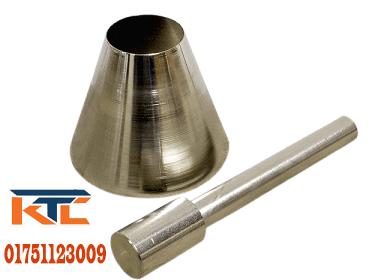
The Cone: This is a brass or plated steel mold shaped as a frustum of a cone (like a funnel with the top cut off).It has specific, standardized dimensions (e.g., about 4$40 \text{ mm}$ top diameter, 5$90 \text{ mm}$ bottom diameter, and 6$75 \text{ mm}$ height).
-
The Tamper: This is a metal rod with a flat circular tamping face (usually about 8$25 \text{ mm}$ in diameter) and a specific, standardized weight (often around 9$340 \text{ g}$).10
What it’s Used For
The primary use of the cone and tamper is to help determine the Saturated Surface-Dry (SSD) condition of the sand. This condition is crucial for calculating two main properties:
-
Specific Gravity and Apparent Density: Measures the density of the sand particles.
-
Water Absorption: Measures how much water the sand can soak up.12
These properties are critical in construction, particularly for:
-
Concrete Mix Design: The amount of water already present in the sand affects the amount of water needed to mix the concrete to achieve the required strength and workability.
🛠️ How it Works (The Testing Procedure)
The “work” of this is part of a standardized test (such as ASTM C128 or BS 812-2) to find the SSD point.14
The Purpose of the Test
The goal is to find the point where the sand’s internal pores are completely filled with water (saturated), but its surface is dry—the Saturated Surface-Dry (SSD) condition.
The Basic Steps
-
Preparation: A sample of sand is first fully soaked in water for $24$ hours to ensure it is completely saturated.
-
Drying: The saturated sand is then slowly dried, usually on a tray, until it reaches a point where it appears dry but still holds water internally.
-
The Cone Test: The partially dried sand is placed into the cone mold and compacted gently using the tamper (usually 25 light drops).
-
Checking for Slump:
-
The cone mold is carefully lifted straight up.
-
If the sand retains the shape of the cone (stands stiff): The sand is still too wet; it contains surface moisture beyond the SSD point. The drying process continues, and the test is repeated.
-
If the sand collapses or slumps (like a sandcastle when the sand is too dry): The sand is assumed to have reached the SSD condition. The slight slump indicates that the surface water film is gone, and the sand can no longer hold the cone shape.
-
Once the sand is confirmed to be in the SSD state, it is weighed and used to perform the necessary calculations for specific gravity and water absorption.
Would you like to know more about the Sand-Cone Method? This is a different test that uses a cone and sand to measure the density of soil in the field.15
cone and tamper sand absorption/SSD cone
Be the first to review “cone and tamper sand”
You must be logged in to post a review.
Related products

Reviews
There are no reviews yet.